


Old South Church in Boston
A Stunning Gilded Age Landmark in the Heart of Copley Square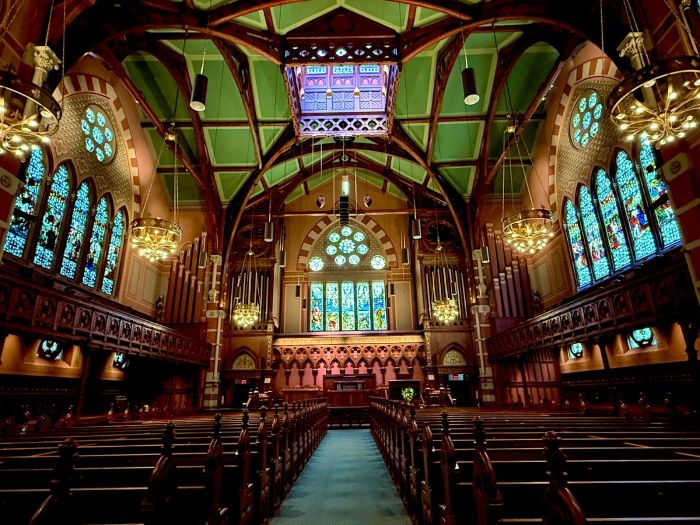
Old South Church in Boston 645 Boylston Street, Copley Square, Back Bay
Where History Meets Splendor
At the corner of Boylston and Dartmouth Streets, anchoring one of Boston's most beloved public squares, Old South Church has stood as a spiritual and architectural landmark for well over a century. With its soaring campanile, richly ornamented stone exterior, and a sanctuary that leaves visitors genuinely breathless, it is one of the most rewarding stops on any Boston itinerary. And best of all, it is free to visit.
A Congregation With Deep Roots
The congregation of Old South Church was gathered in 1669 and has counted Benjamin Franklin, William Dawes, and Samuel Adams among its members. For most of its history the congregation worshipped in what is now known as the Old South Meeting House on Washington Street, a building with its own pivotal place in American history.
It was there that Samuel Adams, James Otis, and Joseph Warren exhorted the people of Boston, and where the meetings that launched the Boston Tea Party were held.
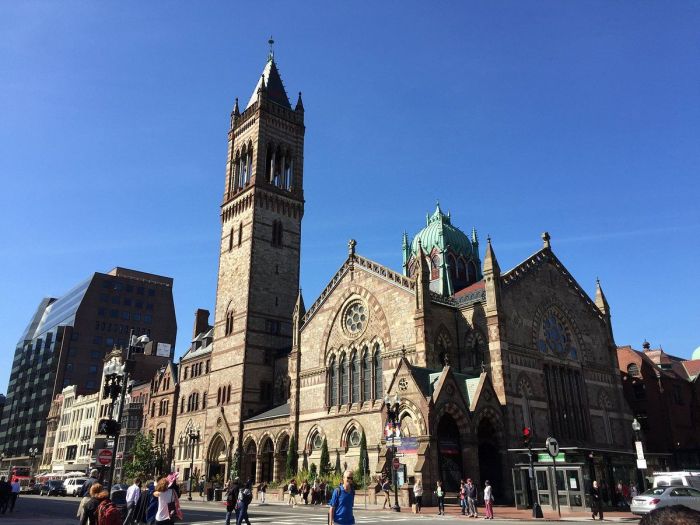
The present church, completed in 1875, is anything but a Puritan meetinghouse. Built during America's Gilded Age, it is colorful, exuberant, and highly ornamented, one of the finest examples of Northern Italian Ruskinian Gothic architecture in the United States.
The Architecture
The building was designed by the Boston architectural firm of Cummings and Sears in the Venetian Gothic style, following the principles of British cultural theorist John Ruskin as outlined in his treatise The Stones of Venice. The two architects admired their own work enough to have their likenesses carved into stone columns in the portico, a detail worth hunting for on your way in.
The exterior is primarily built of Roxbury Conglomerate, commonly called called puddingstone, with many arches and walls striped with alternating courses of yellow-beige and deep red sandstone. The effect is warm, layered, and unmistakably Victorian. Rising above it all is a campanile that reaches 246 feet into the Copley Square skyline, its bell audible across the surrounding neighborhoods.
Inside the Sanctuary
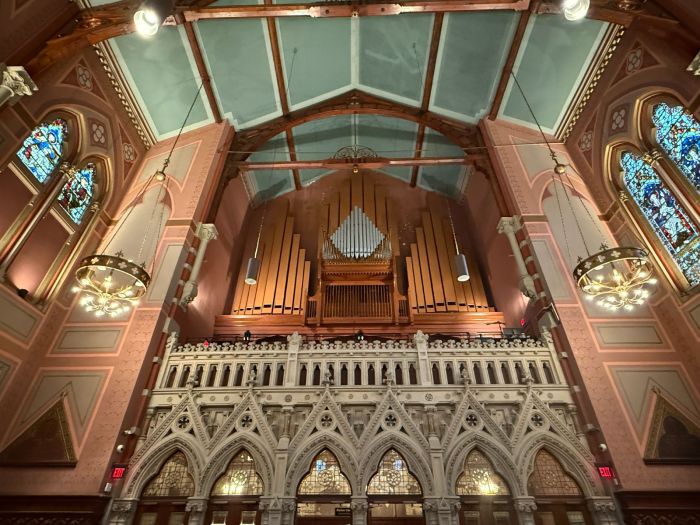
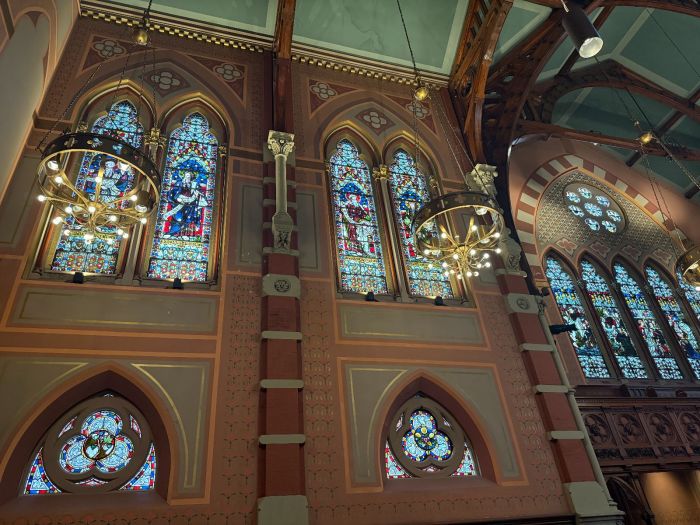
Step through the entrance and the interior opens up in a way that consistently surprises first-time visitors. The sanctuary features highly carved Italian cherry woodwork, limestone, stenciled plaster, and stained glass. The narthex screen is carved in the Venetian Gothic style from French Caen limestone, and hidden among the carved foliage are a squirrel, lizard, owl, and snail. Take a moment to look for them.
The interior of the chancel, behind the choir, is faced by a running screen of wooden arches with quatrefoil lunettes adapted from the upper arcade of the Doge's Palace in Venice. Overhead, great wooden trusses in the style of northern Italian Gothic architecture draw the eye upward toward a painted ceiling and a copper lantern that floods the nave with natural light.
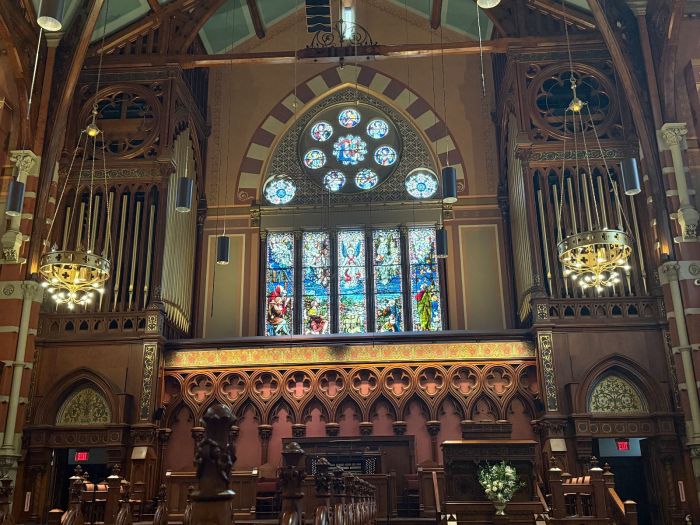
The walls are painted in rose madder and decorated with intricate polychrome stencil patterns in ochre, bay leaf green, warm gray, and persimmon with touches of metallic gold, restored in 1984 to match the original 1875 appearance as closely as possible.
The Stained Glass
The stained glass windows are by the English manufacturers Clayton and Bell and were produced in the style of 15th-century English glass. They fill the sanctuary with rich color throughout the day. On the south wall, windows depict the Four Evangelists: Matthew, Mark, Luke, and John.
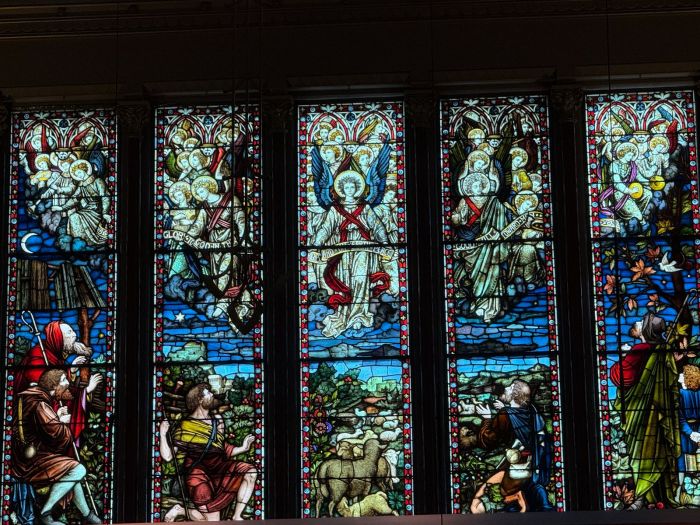
On the north wall opposite them are the four Old Testament Prophets: Isaiah, Jeremiah, Ezekiel, and Daniel. Additional windows feature sunflowers and lilies, adding warmth and botanical beauty to the biblical program.
The interplay between the windows and the painted interior creates an atmosphere that is layered, glowing, and unlike anything else in Boston.
A Tiffany Chapter
Louis Comfort Tiffany does have a place in Old South's story. In 1905, Tiffany replaced the original interior stenciling with his own design in purple and metallic silver, and covered the Clayton and Bell stained glass with insets of purple glass.
That ambitious scheme was later painted over in the 1950s, and a careful restoration in 1984 returned the interior to its original Cummings and Sears vision using historic photographs and paint analysis as guides.
Plan Your Visit
Old South Church is open to visitors Sunday through Friday, with no admission charge. The church is located in Copley Square at the corner of Boylston and Dartmouth Streets, steps from the MBTA Green Line Copley station. Trinity Church and the Boston Public Library are directly across the square. Self-guided tour materials are available inside. For current service times, concerts, and events, visit oldsouth.org.

Stacey Sao has been the Managing Director of the family-friendly events and activities website, BostonCentral for over 25 years. She continues to enjoy discovering and exploring new places to visit in the Greater Boston area.