Dancing Through the Stars
You are Viewing a Past Event
If this is a recurring event that will be happening again this year, please let us know.
If this is a recurring event that will be happening again this year, please let us know.
| Dates: | Sun from 1/26/25 - 1/26/25 |
| Hours: | 3:00-5:00 PM |
| Ages: | Kids, Teens, Adults |
| In/Outdoor: | Indoor |
| Cost: | Free see below |
| Category: | Music & Concerts |

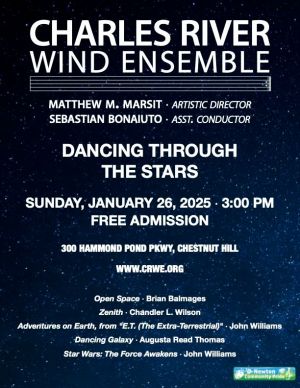 Open Space, in the composer’s own words, is: “easily one of the most intriguing pieces I have written in my career as a composer.” The work was inspired by the composer’s friend, G.
Reid Wiseman, a NASA astronaut.
Wiseman spent two years preparing to launch and spent six months on the International Space Station, where he actually served when Open Space was premiered.
Zenith is full of rhythmic excitement and finely tuned transitions with the intent of capturing some of the classic flare and compositional style of the composer’s mentor and friend Dr, Julian E.
White, Distinguished Professor of Music (retired), Florida A&M University, to whom the work is dedicated.
The 1982 film E.T. the Extra-Terrestrial offered another seismic success in the relationship between John Williams and Steven Spielberg, and a decision the latter made during the recording process demonstrates the respect each man had for the contributions of the other.
Williams was recording the lengthy and complex music for the finale of the film, but he was having difficulty synchronizing the orchestra’s performance to the many precise cuts and beats of the picture edit.
After several takes, Spielberg offered to turn off the film and allow Williams to record the music on its own, with exactly the tempi and phrasing he felt the music required.
The composer describes Dancing Galaxy as a set of three dances.
The first starts in the lowest register of the wind ensemble in a timeless, floating, and gradually rising tune, which for a brief moment creates an impression of the massive, enduring universe.
The music reaches upward and gains momentum, pushing through majestic, fanfare-like music, until it arrives at a driving, relentless dance.
Punchy repeated rhythms propel the dance while a counter tune hammers with hard accents against the forceful rhythm; all the while, brass fanfares challenge the flow.
John Williams (1932 - ) / trans. Paul Lavender (1952 - ), Suite from “Star Wars: The Force Awakens”
When the American Film Institute released their listing of the top twenty-five film scores of all time in 2005, it included the titles: Out of Africa, Sunset Boulevard, Ben-Hur, Psycho, The Godfather, and Gone with the Wind.
John Williams was responsible for three of those twenty-five selections, and at the very top was his unforgettable score to the original Star Wars movie.
On the heels of his work in the 1970s with Steven Spielberg that produced the blockbusters Jaws and Close Encounters of the Third Kind, Williams signed on in 1977 to score a new “space western” written and directed by George Lucas.
At that time, no one could have predicted the global popularity of this film and its successive chapters, nor could Williams have imagined the impact that his music for the movies would have both in the world of film and well beyond.
Williams has scored dozens of themes for the nine films in the series, many of which have achieved world-wide recognition on a scale equal to some of the most popular classical music in history.
| COST | ↑ top |
FREE
| WEBSITE | ↑ top |
| LOCATION | ↑ top |
300 Hammond Pond Parkway, Chestnut HIll, MA, 02467 map
| RELATED LINKS | ↑ top |
- Profiles
- Localities
Info changes frequently. We cannot warrant it. Verify with Dancing Through the Stars before making the trek. If you find an error, please report it...