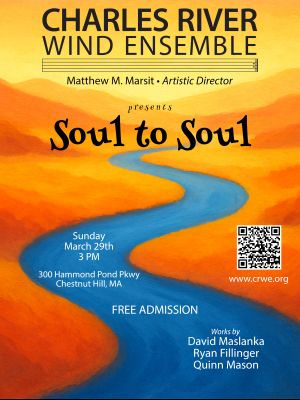
Soul to Soul
You are Viewing a Past Event
If this is a recurring event that will be happening again this year, please let us know.
If this is a recurring event that will be happening again this year, please let us know.
| Dates: | Sun from 3/29/26 - 3/29/26 |
| Hours: | 3:00 PM |
| Ages: | Kids, Teens, Adults |
| In/Outdoor: | Indoor |
| Cost: | Free see below |
| Category: | Music & Concerts |

 Program notes by Richard M. Kesner
Ryan Fillinger (2001 - ), Sinfonietta Ryan Fillinger is an Oregon-born composer of wind ensemble, orchestral, and chamber music.
His works fuse styles of the 18th, 19th, and 20th Century with modern techniques and contemporary instrumentation.
Sinfonietta, for wind ensemble, is structured into two movements; the first, marked “slowly, reflectively” draws inspiration from the serenity of the middle movement of Ravel's Piano Concerto in G Major, featuring a similarly extensive and melancholic run-on melody that repeats only twice over the course of the movement.
The second movement, marked “quickly, with energy,” immediately changes pace with a sudden burst of forward-moving energy, and maintains its momentum throughout its modified rondo form until the final bar.
Quinn Mason (1996 - ), Soul to Soul Quinn Mason is a composer and conductor based in Dallas, Texas.
He currently serves as the Hartford Symphony Orchestra’s Artist in Residence.
Mason composed Soul to Soul as an “elegy for Wind Ensemble” in 2017 and subsequently revised it in 2019.
The work was written in the memory of Dr. David Maslanka (1943-2017), with whom Mason worked closely for a brief period in February 2017.
The work is a tribute to Dr. Maslanka and his unique style of writing for wind ensemble, complete with brass and wind chorales and hopeful trumpet fanfares.
In addition to the chorales, this piece also contains a quote from Maslanka’s 8th Symphony.
David Maslanka (1943-2017), Symphony No 10
David Maslanka was born in New Bedford, Massachusetts in 1943.
He attended the Oberlin College Conservatory where he studied composition with Joseph Wood.
Among his more than 150 compositions are over 50 pieces for wind ensemble, including ten symphonies, seventeen concertos, a Mass, and many concert pieces.
His chamber music includes four wind quintets, five saxophone quartets, and many works for solo instrument and piano.
Maslanka served on the faculties of the State University of New York at Geneseo, Sarah Lawrence College, New York University, and Kingsborough Community College of the City University of New York..
Maslanka passed away while writing this final work.
His son, Matthew completed the composition based on his father’s sketches.
According to David, the work began with two visions or dreams of “the Holy Mother takes me sliding down a rocky mountain slope, all loose small rocks,” and “the Holy Mother in the guise of an 18-year-old Swiss farm [shows me] views of the earth and the oceans.” As he began writing, his inner compass pulled him forward – as he put it - “into the humble world of the chorales.
A pattern began to emerge of a chorale and a response, the response being the evolution of a radically simple, intimate, and beautiful melody.
This process kept repeating itself until half a dozen of these melodic pairings began to emerge.”
At the time of his death, David had fully completed the first movement and half of the second.
The remainder of the second movement and the whole of the fourth movement were sketched out.
The third movement had an opening sketched, but the rest was in fragments.
The composer asked his son to finish the work, drawing on the sketches and then piecing the sections together.
The first movement “Alison” was written for his wife who was dying of an immune disorder in the spring of 2017.
This movement may be seen through that lens, with bitter rage at the coming loss and a beautiful song full of love.
The second movement’s title, “Mother and Boy Watching the River of Time,” comes from David’s final pencil sketch of the same name.
It depicts two small figures sitting on a riverbank in front of a forest and mountain foothills.
The music is largely a transcription of the second movement of the euphonium sonata he wrote for Matthew, Song Lines.
The third movement center on “The Song at the Heart of it All,” Matthew’s response to the deaths of his mother and father.
The fourth movement, “One Breath in Peace,” is about acceptance and the ability to move forward after loss.
The long solo lines for oboe reflect the Bach chorale, Jesu, der du meine Seele.
The Symphony closes with the last statement of the chorale, with the pianist singing the tenor line
| COST | ↑ top |
FREE
| WEBSITE | ↑ top |
www.crwe.org/copy-of-2024-2025-season
| LOCATION | ↑ top |
300 Hammond Pond Parkway, Chestnut Hill, MA, 02467 map
| RELATED LINKS | ↑ top |
- Profiles
Info changes frequently. We cannot warrant it. Verify with Soul to Soul before making the trek. If you find an error, please report it...